
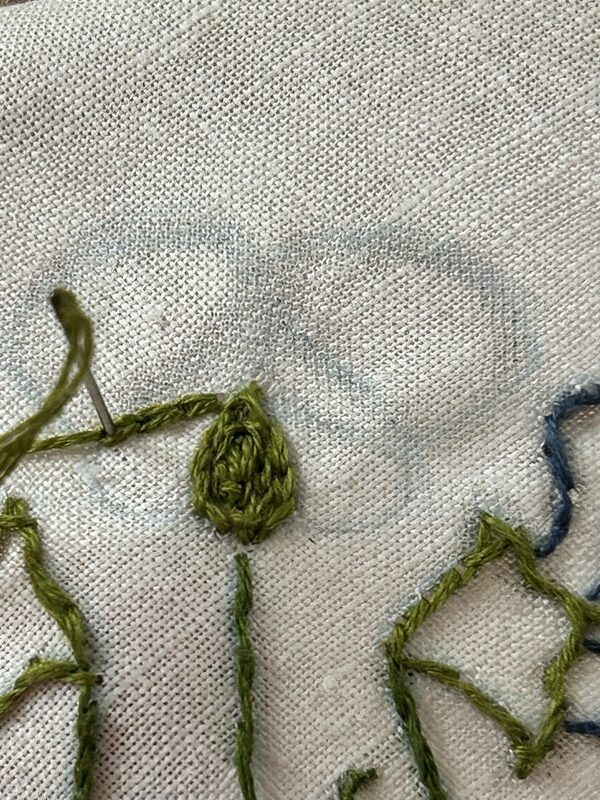
The leaves were the first section I tackled after the vines, and they immediately pushed me out of my comfort zone. I worked them in a lighter modern green (collateral damage from the Great Michaels Thread‑Matching Meltdown) and used two stitches: satin stitch for the vine leaves and chain stitch for the flower sepals.
The chain stitch was a surprise. I had never attempted it before, and yet several early twentieth‑century manuals describe it as the foundational stitch, the one every embroideress supposedly learned first. I had always assumed that honor belonged to satin or back stitch. The chain stitch is called so because it looks like a chain (embroiderers are often not poets). Made by bringing the needle up, then going back down in the same hole, leaving a loop, and passing the needle through that loop to form a “link” before repeating
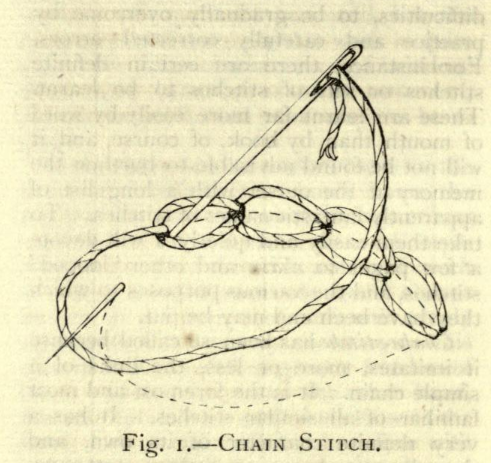
by May Morris 1862-1938
The satin stitch, too, required a shift in mindset. I usually default to the “thread‑saver satin,” where the front of the fabric gets the same smooth, flat coverage, but the back is worked with tiny anchoring stitches instead of full repeats. It’s faster, it wastes less thread, and it means fewer interruptions to tie off and rethread all things I like when I’m working on modern projects.
But this project kept nudging me away from speed and convenience. True satin stitch, the kind that mirrors itself front and back, is slower. It eats thread. It forces you to commit to each stroke of the needle. And while it absolutely wrecked my carefully planned timeline and pushed me closer to the deadline than I’d like to admit, I think I’m better for it.
The Arts & Crafts Movement prized slowness, deliberateness, and the dignity of doing something the long way simply because it was the right way. Stitching these leaves made me feel that in my hands. the tug of the thread, the rhythm of repetition, the quiet insistence that beauty takes time.