
Embroidery has long been intertwined with the history of dress and gender. In early modern Europe, needlework functioned as a marker of refinement and social status. As Jennifer Van Horn demonstrates, embroidered samplers and textiles acted as social documents, evidence of a woman’s discipline, gentility, and place within the household economy.¹
By the nineteenth century, embroidery occupied an even more complex position within fashion. It adorned garments and accessories, yet it also represented a form of gendered labor that was aesthetically prized even as it was socially undervalued. Kathryn King argues that needlework was both a creative and intellectual practice, yet it was frequently dismissed as trivial “women’s work.”² This tension shaped the conditions under which women produced embroidered fashion and helps explain why the Arts & Crafts Movement became such a powerful site for rethinking the relationship between labor and beauty.
The movement’s revival of hand embroidery tried to reframe it as a legitimate art form. May Morris, for example, transformed embroidery from a domestic pastime into a professionalized craft. Her designs for clothing and household textiles emphasized stylized natural motifs, harmonious color palettes, and the expressive potential of stitch.³ Similarly Workshops such as the Dun Emer Guild and Hastings Needle Work, extended this ethos by creating spaces where women could design, produce, and sell embroidered goods.⁴ These workshops blurred the boundaries between fashion, labor, and art, demonstrating that embroidery could be both economically viable and artistically innovative.
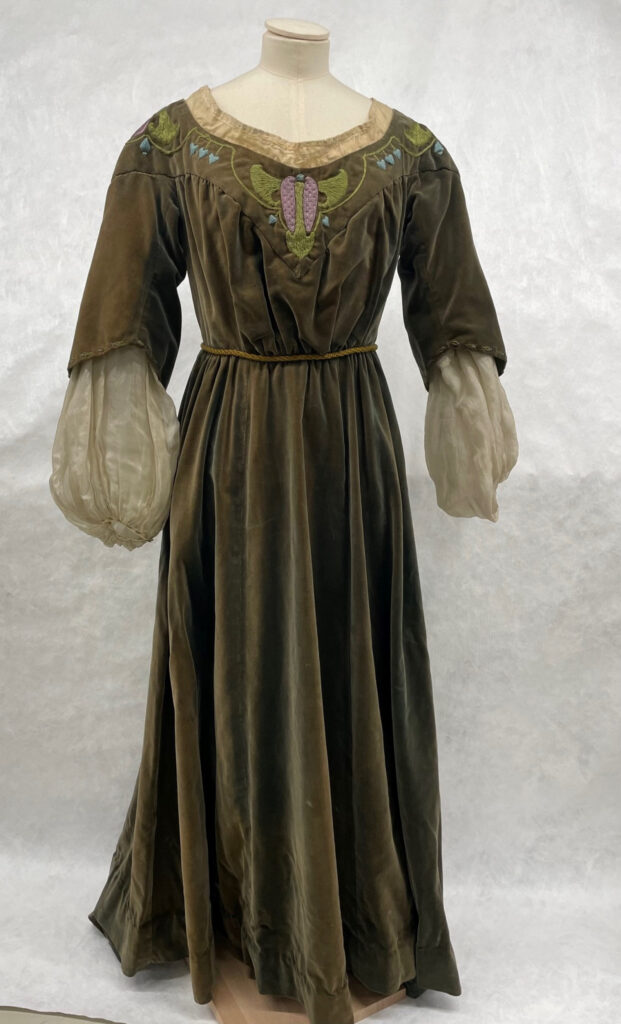
Moreover the Arts & Crafts Movement did not merely influence interiors and decorative arts. It reshaped fashion itself. As the Victoria & Albert Museum notes, the movement encouraged designers to reject the excesses of industrially produced clothing and instead embrace garments that expressed simplicity and ture craftsmanship.⁵ This shift aligned with broader dress‑reform movements that sought alternatives to the restrictive Victorian silhouettes. Arts & Crafts dress favored looser cuts, natural fibers, and ornamentation achieved through handwork rather than machine‑made trims.
Fashion Heritage Europe similarly emphasizes that Arts & Crafts ideals offered “the other side of modernity”: a vision of fashion grounded in slowness and authenticity. ⁶ Instead of chasing novelty, it pushed designers drew on medieval and folk traditions, creating garments that felt timeless rather than trendy. Embroidery became a key site for this philosophy, allowing wearers to display individuality through its patterns and designs As Arts & Crafts aesthetics filtered into mainstream fashion those principles shaped everything from tea gowns to accessories, creating a recognizable Arts & Crafts “look”
This broader history of embroidered dress and accessories provides the context for understanding the handkerchief as a fashion object. Though small, the handkerchief has carried enormous cultural weight. As the Complete Handkerchief History notes, it has long served as a symbol of refinement, flirtation, and social status.⁸ In the Renaissance, Bella Mirabella shows, the handkerchief occupied a limbo space between the intimate and the public: a cloth meant to absorb bodily fluids also signaled hygiene and social identity.⁹ This duality requires distinguishing between the utilitarian handkerchief and the decorative one, the latter functioning as a personal, wearable accessory. Women embroidered decorative handkerchiefs as gifts, love tokens, and ways to display their skill.
These earlier traditions became pillars for the Arts & Crafts Movement, which deliberately revived and romanticized historical approaches to needlework as a way to reclaim authenticity in everyday accessories. By the nineteenth century, decorative handkerchiefs were essential elements of dress for both men and women. They were tucked into sleeves, waistcoats, and pockets. They could be edged with lace, monogrammed, or elaborately embroidered. My project happens to be all three. As Amy Boyce Osaki notes, sewing and needlework were considered “truly feminine employment,” and the handkerchief once again became a canvas on which women demonstrated refinement and technical mastery.¹⁰ Even when small, these textiles participated in the visual language of dress.
Footnotes
- Jennifer Van Horn, “Samplers, Gentility, and the Middling Sort,” Winterthur Portfolio 40, no. 4 (2005): 219–48.
- Kathryn R. King, “Of Needles and Pens and Women’s Work,” Tulsa Studies in Women’s Literature 14, no. 1 (1995): 77–93.
- May Morris, “Embroidery,” The Decorator and Furnisher 21, no. 5 (1893): 178–79.
- Nicola Gordon Bowe, “Two Early Twentieth-Century Irish Arts and Crafts Workshops in Context,” Journal of Design History 2, no. 2/3 (1989): 193–206; Ann W. Braaten, “Hastings Needle Work: Women Creating, Women Providing,” Minnesota History 60, no. 2 (2006): 66–76.
- “How Arts and Crafts Influenced Fashion,” Victoria & Albert Museum, accessed April 2026.
- “Fashion and the Arts and Crafts Movement: The Other Side of Modernity,” Fashion Heritage Europe, accessed April 2026.
- “How the Arts and Crafts Movement Influenced Fashion,” ECER, accessed April 2026.
- The Complete Handkerchief History, Hankybook, accessed April 2026.
- Bella Mirabella, “Embellishing Herself with a Cloth: The Contradictory Life of the Handkerchief,” in Ornamentalism: The Art of Renaissance Accessories (2011), 59–82.
- Amy Boyce Osaki, “‘A Truly Feminine Employment’: Sewing and the Early Nineteenth-Century Woman,” Winterthur Portfolio 23, no. 4 (1988): 225–41.