
As I begin sewing the vines that frame my handkerchief, one of the most invaluable resources at my side is Decorative Needlework by May Morris. I grew up learning to sew from my mother and grandmother, which puts me in good company with countless women across history.Needlework manuals were widely read, but most women already carried a foundation of inherited knowledge learned at kitchen tables, in parlors, or perched beside an older relative. In that sense, I’m no different.
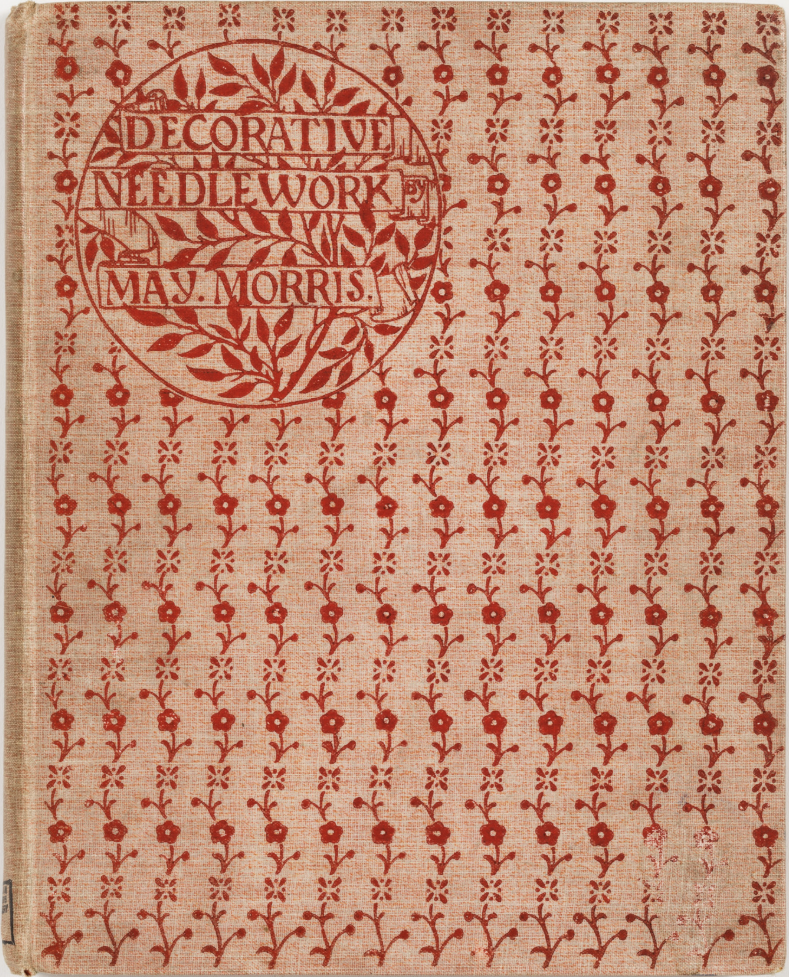
But even with that lineage behind me, May Morris became my constant companion. So much so I developed a running philosophy for this project “Ask May”. When in doubt about stitch direction, thread thickness, or the eternal question of “Is this ugly or am I just tired?” I turned to her.
I started the outlining with a mid‑dark green thread, the closest modern match being DMC 937. Most sources recommend using one or two strands for detailing, so I chose two. Immediately, I found myself playing the most stressful game of thread chicken (trying to finish a section before running out of thread). I almost made it to the end without needing a replacement. This proved a problem, because the green came from my heirloom collection, I couldn’t simply buy more. My only option was to find a modern shade.
While I labeled the closest DMC match, color matching is not an exact science. The modern 937 was brighter, a little more yellow, and to my horror noticeably different. It’s a silly thing to spiral over, but in the moment it felt catastrophic. I was crushed that my work wouldn’t look the way I envisioned. I was mad at myself for not choosing a different green from the start. And yes, I am proud to report that I did not cry in the middle of Michaels… I waited until I got to the car.
My boyfriend, bless him, tried to cheer me up by reminding me that the project was never going to be perfect anyway. (This did not help.) What did help was his follow‑up: that the piece would be more impressive if I worked with what I had rather than chasing absolute perfection. That comment reminded me of the Morris family motto: “Si Je Puis” which translates to “If I can,” or “As best I can.” It’s a simple phrase, but Si Je Puis doesn’t promise flawlessness; it promises effort. It acknowledges the limits of the maker and insists that “perfect” lies in doing what you can with what you have. William Morris and his circle never pretended that handwork could rival the mechanical precision of a machine. In fact, they argued the opposite: that the small irregularities in the work were what made it meaningful. Perfectionism, on the other hand, demands the impossible. It tells you that a single mismatched thread color ruins the whole piece. It convinces you that a mistake is a failure and whispers that if you can’t do something flawlessly, you shouldn’t do it at all. Si Je Puis is the antidote to that voice. It gives permission to try and adapt, to be a craftsperson rather than a machine.
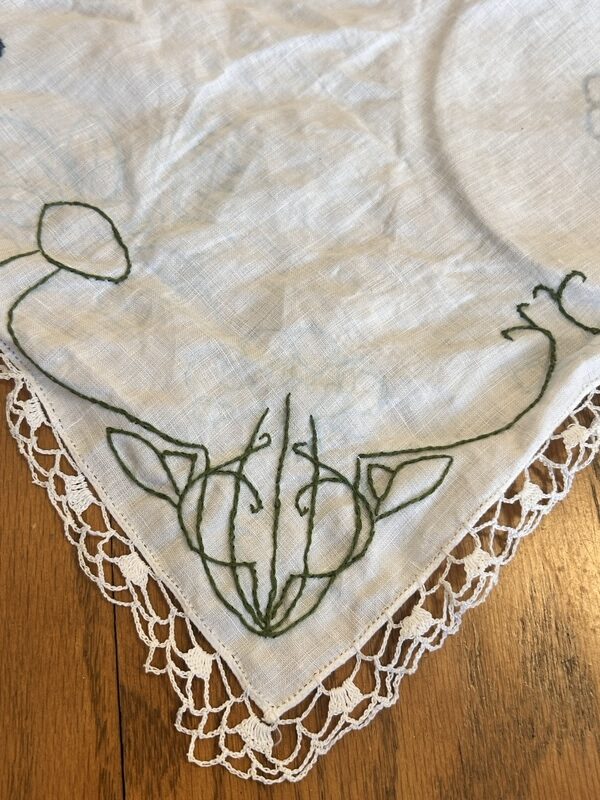
Once I let myself breathe, I came up with the next‑best solution. I took one skein that was too dark and one that was too light, twisted them together, and let the eye blend them into something close to the original shade. I think it worked. I’m hyper‑aware of the difference, and I suspect the people in my life when asked if it’s noticeable are too scared to tell me otherwise. But whether the transition is seamless or not, I’ve decided to let it stand as an honest reflection of my craftsmanship. Accepting imperfection is easier said than done, But the Arts & Crafts Movement wasn’t about flawless replication. It was about the visible presence of the maker, the small irregularities that prove a human being was here.