Introduction

At the turn of the twentieth century, The Arts & Crafts Movement tried to reshape the way people thought about making. It challenged the rise of industrial mass production by returning to the slow, deliberate work of the hand and the dignity in labor. In doing so, it help elevated embroidery and other fabric crafts from a domestic pastime to an artistic practice.

This blog is my attempt to step inside that world.

For my fashion history final project, I’m exploring how the Arts & Crafts Movement shaped early twentieth‑century embroidery in its motifs, its materials, its techniques, and the values embedded in every stitch. I’ll be recreating a period embroidery pattern using historically informed methods/materials and, documenting the process as I go. Think of this blog as part research notebook, part process journal, part reflection on what it means to make something slowly in a fast world.

Throughout the blog, you’ll find posts that will update on the piece as I go, then an a essay to go along with each entry. finally at the end I willl share my final reflections and and visual analysis.

My goal isn’t just to explain what Arts & Crafts embroidery was, but to understand what it felt like, what it demanded of the maker, what it revealed about the era, and why it still resonates today.

If you’re interested in fashion history, textile arts, or the stories that live in handmade objects, I’m glad you’re here. Let’s stitch our way into the past together.

© William Morris Gallery, London Borough of Waltham Forest
Photography close up of a red flower.
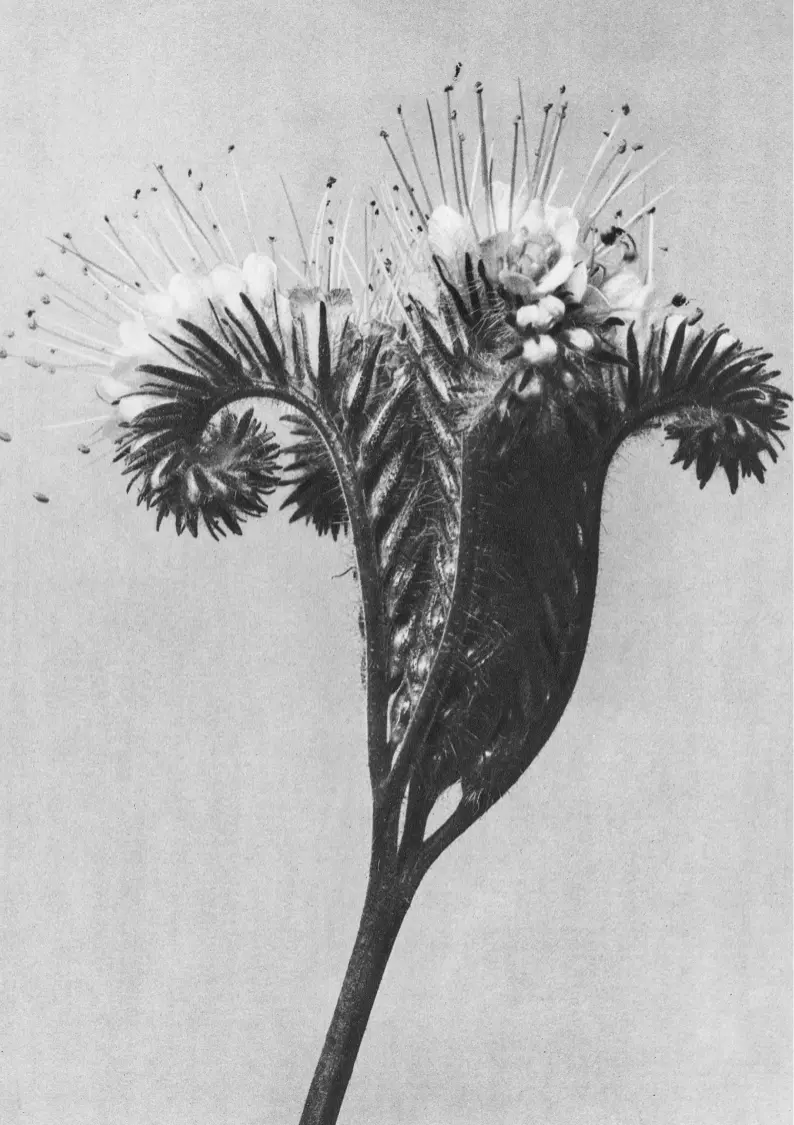
Black and white photography close up of a flower.

The Arts & Crafts Movement

The Arts & Crafts Movement emerged in late nineteenth century britain as both a critique of industrial modernity and a reimagining of what craftsmanship could mean in everyday life. A philosophy that sought to reunite art with craft, maker with material, and aesthetic pleasure with moral purpose. To understand the movement’s ideals, it is necessary to look at the broader historical picture .

Industrialization had transformed the landscape of western civilization. Factories produced goods at unprecedented speed, but at the cost of the worker’s dignity. As Alan Crawford argues, the movement was fundamentally about “ideas and objects” , a belief that the things people lived with and used should reflect care and human creativity rather than mechanized uniformity. William Morris, its most iconic figure, believed that beauty was a human right and that meaningful work was essential to a fulfilling life.  This philosophy extended into design education. Manuals such as Art in Needlework by Lewis F. Day and Mary Buckle, and the Treatise on Embroidery, emphasized not only technique but the moral and intellectual value of handwork. They encouraged the stitcher to have a deep understanding of the material they work with. May Morris, another prominent figure, insisted that embroidery was an art requiring both imagination and discipline.

At its core, the Arts & Crafts Movement was a call to revalue the handmade. It sought to restore the connection between maker and object resisting the alienation of industrial labor. Though its ideals were not always realized in practice, its philosophy continues to resonate..

Tag: Progress Journal

the post that are updates on my progress

  • Stitching the Vines: Let Go of Perfection

    Stitching the Vines: Let Go of Perfection

    As I begin sewing the vines that frame my handkerchief, one of the most invaluable resources at my side is Decorative Needlework by May Morris. I grew up learning to sew from my mother and grandmother, which puts me in good company with countless women across history.Needlework manuals were widely read, but most women already carried a foundation of inherited knowledge learned at kitchen tables, in parlors, or perched beside an older relative. In that sense, I’m no different.
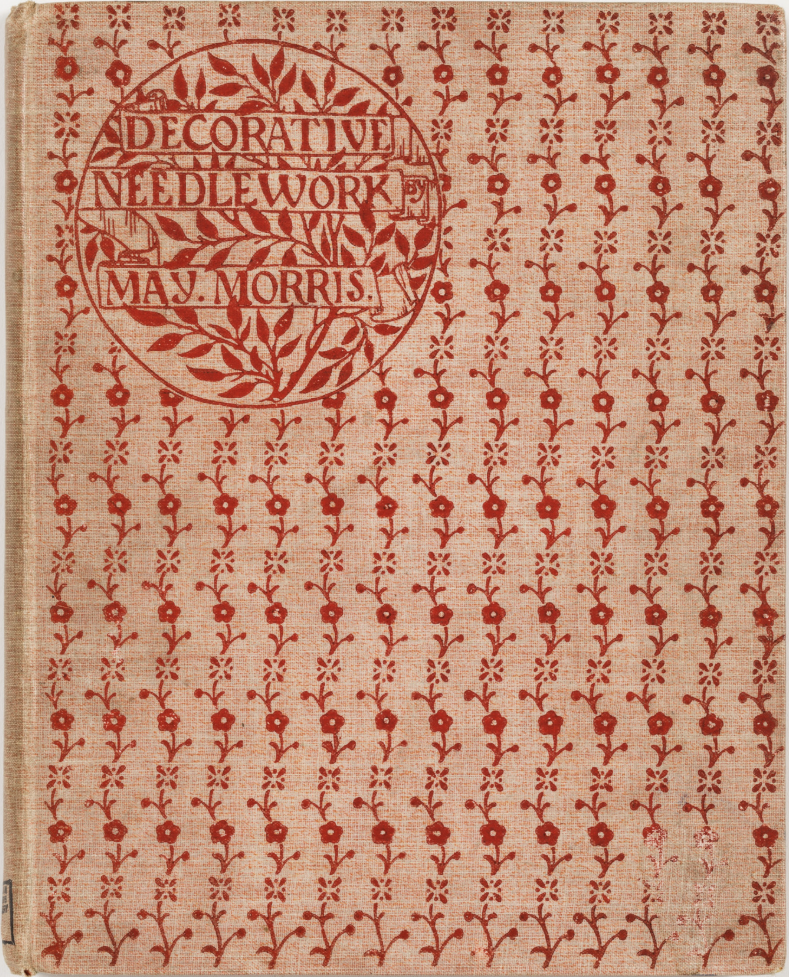
    But even with that lineage behind me, May Morris became my constant companion. So much so I developed a running philosophy for this project “Ask May”. When in doubt  about stitch direction, thread thickness, or the eternal question of “Is this ugly or am I just tired?”  I turned to her.

    I started the outlining with a mid‑dark green thread, the closest modern match being DMC 937. Most sources recommend using one or two strands for detailing, so I chose two. Immediately, I found myself playing the most stressful game of thread chicken (trying to finish a section before running out of thread). I almost made it to the end without needing a replacement. This proved a problem, because the green came from my heirloom collection, I couldn’t simply buy more. My only option was to find a modern shade.

    While I labeled the closest DMC match, color matching is not an exact science. The modern 937 was brighter, a little more yellow, and to my horror noticeably different. It’s a silly thing to spiral over, but in the moment it felt catastrophic. I was crushed that my work wouldn’t look the way I envisioned. I was mad at myself for not choosing a different green from the start. And yes, I am proud to report that I did not cry in the middle of Michaels… I waited until I got to the car.

    My boyfriend, bless him, tried to cheer me up by reminding me that the project was never going to be perfect anyway. (This did not help.) What did help was his follow‑up: that the piece would be more impressive if I worked with what I had rather than chasing absolute perfection. That comment reminded me of the Morris family motto: “Si Je Puis” which translates to “If I can,” or “As best I can.”  It’s a simple phrase, but Si Je Puis doesn’t promise flawlessness; it promises effort. It acknowledges the limits of the maker and insists that “perfect” lies in doing what you can with what you have. William Morris and his circle never pretended that handwork could rival the mechanical precision of a machine. In fact, they argued the opposite: that the small irregularities in the work were what made it meaningful. Perfectionism, on the other hand, demands the impossible. It tells you that a single mismatched thread color ruins the whole piece. It convinces you that a mistake is a failure and whispers that if you can’t do something flawlessly, you shouldn’t do it at all. Si Je Puis is the antidote to that voice. It gives permission to try and adapt, to be a craftsperson rather than a machine.
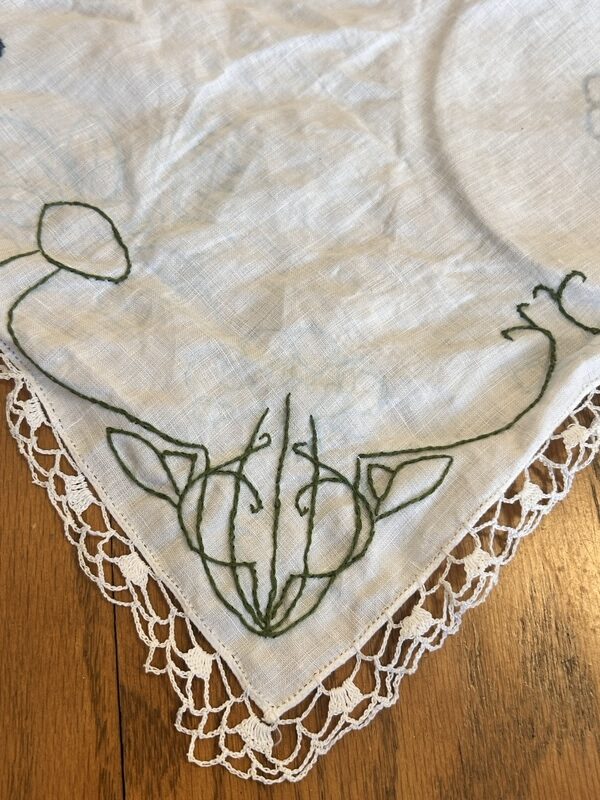
    Once I let myself breathe, I came up with the next‑best solution. I took one skein that was too dark and one that was too light, twisted them together, and let the eye blend them into something close to the original shade. I think it worked. I’m hyper‑aware of the difference, and I suspect the people in my life when asked if it’s noticeable are too scared to tell me otherwise. But whether the transition is seamless or not, I’ve decided to let it stand as an honest reflection of my craftsmanship. Accepting imperfection is easier said than done, But the Arts & Crafts Movement wasn’t about flawless replication. It was about the visible presence of the maker, the small irregularities that prove a human being was here.

  • Choosing a Pattern

    Choosing a Pattern

    My first instinct was to imitate the work of William Morris and the women in his family Jane, May, and Jenny Morris, whose embroidery helped define the movement’s aesthetic. Their designs are lush, intricate, and deeply tempting. But I am an amateur embroideress with a ten‑week deadline, not a Morris daughter with a lifetime of practice and a workshop at my disposal.

    So I turned to A Treatise on Art Needlework and the publications of the Royal School of Art Needlework for guidance. While searching I was also researching books and articles that didn’t necessarily offer patterns but discussed the theory and ideas circulating around needlework at the time. “Embroidery or The Craft of The Needle” by W.G. Paulson Townsend, originally published in 1907 had one passage in particular shifted my approach:

    “The embroideress is continually being called upon to adapt or modify the designs she embroiders… she will find plenty of scope for her individuality and taste in planning and adapting design.”

    In other words: the Arts & Crafts Movement valued originality, not replication. The goal wasn’t to copy a design perfectly but to imbue it with the maker’s own sensibility. That realization freed me from the pressure of producing an exact historical replica and allowed me to create something historically informed yet personal. All the same I still needed a jumping off point.

    I eventually chose a pattern from Designs for Needlework by Liberty & Co., preserved in the Lila M. O’Neale Collection at the University of California. Pattern No. 221 became my base. I tweaked it, adding botanical motifs inspired by other pages in the booklet, carving out a place for my initials, and sketching out variations. The original design was meant to be worked in a single color, but as I considered how to make the piece feel like mine, I kept glancing at the bouquet of spring flowers on my desk. Their colors brightened my dorm room and brought me such joy that I wanted to make my work a celebration of their natural beauty. So I experimented with color combinations until I found one that felt right: joyful, organic, and following the movement’s preference for solid, block shading.

    With the design finalized, I turned to the tools

    Hoop

    I can, in good faith, use a modern wooden tambour hoop for this project. According to the Embroiderers’ Guild of America, the basic construction of these hoops has remained unchanged since the eighteenth century.

    Needles

    Similar to the hoop, the basic eye‑hole needle has existed since the Gravettian period (31,000–20,000 BCE), and its design has barely changed. Furthermore during the industrial revolution sewing needles were rolled in asbestos powder to stop them from rusting so perhaps it’s best to stick with the modern.

    Threads

    This is where things get complicated. My grandmother passed down a box of embroidery floss that had been added to by her mother and aunt. Meaning some of the floss dates back to the 1910s–1930s, easily identifiable by their visible age and by my great‑grandmother’s impeccable record‑keeping. A few skeins are labeled “RICHSC,” shorthand for the Richardson Silk Company, which merged with the Heminway Silk Company in 1925. Other big names pop up like the Clark Thread co. The American Thread Co. and of course the tried and true DMC. Honestly it was exciting to sort and research them. These threads are tiny time capsules.

    Unfortunately, they are also hideous. The oldest colors range from bruise purple to baby‑puke green, likely the reason they’ve remained untouched for decades. Still, I managed to find enough older floss that only 30% of the design will be done in modern thread, which I’m counting as a succses. Most of them failed the pull test (true to its name a method for testing the strength of old thread by yanking on it) and if I was making this item for daily use I would switch to stronger thread but a project like this is realistic the only time the thread could be used. It just means I need to take extra precautions when washing and ironing it.


    the Arts & Crafts Movement was about reclaiming the dignity of handwork in an industrial age. It championed slowness, intentionality, and the idea that beauty should be accessible in everyday objects. It also rejected mass‑produced uniformity in favor of the visible presence of the maker’s hand. In preparing this project I’ve found myself reenacting the very principles the movement held dear. Next comes the stitching itself, the slow, meditative work that transforms a pattern into something living. But for now, the groundwork is laid. 

  • Finding the canvas

    Finding the canvas

    Before I could put a single stitch into cloth, I had to answer a deceptively simple question: what exactly am I going to embroider? The Arts & Crafts Movement left behind a vast archive of patterns, and motifs, but the practical reality of recreating a piece from the early twentieth century begins with something far more mundane: finding a pattern that I can actually transfer onto fabric.

    By the late 1800s, pre‑stamped fabrics and iron‑on transfers were widely available. In theory, I could have hunted down an original pre‑printed square of linen or cotton from the period. In practice, the chances of finding a 100‑plus‑year‑old transfer in good condition tucked behind a stack of Depression glass in my local antique shops are…slim to say the least. So I turned to a method with a much longer history: pouncing.

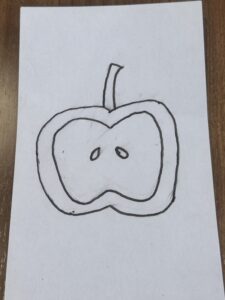
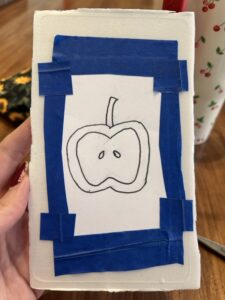
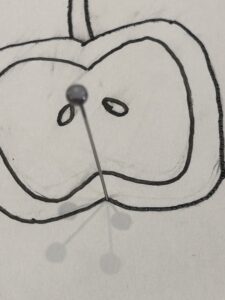
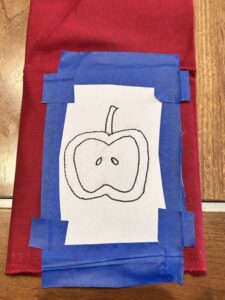
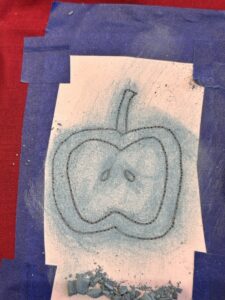
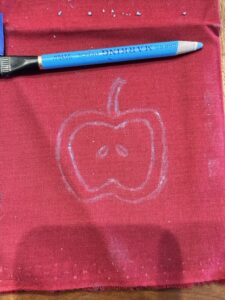
    “Prick and pounce” is a transfer technique that predates the Arts & Crafts Movement by centuries. First you draw up your pattern, prick tiny holes along the lines of a paper pattern, lay it on your fabric, and dust it with chalk or pouncing  powder. The pigment falls through the holes, leaving a connect-the-dots outline of the design. It’s painfully slow but dependable for good results.

    But before I could pounce anything, I had to decide what I was embroidering on. The movement embraced everything from book covers to table linens, but for the sake of time, materials, and my own sanity, I settled on a decorative handkerchief. It’s small enough to complete in ten weeks, historically appropriate, and has a long history as fashion accessories. While the handkerchief I found in an antique shop isn’t from 1900, its lightweight cotton construction is similar to period examples and frankly, even if I had found a blank square from the era, there’s no guarantee it would still be strong enough to stitch into. With that I can move forward to the next step