

- Better Homes & Gardens. “The Revival of the Arts and Crafts Movement—What This Means for Your Home.” Accessed March 17, 2026. https://www.bhg.com/modern-arts-and-crafts-movement-11927845.
- Bowe, Nicola Gordon. “Two Early Twentieth-Century Irish Arts and Crafts Workshops in Context: An Túr Gloine and the Dun Emer Guild and Industries.” Journal of Design History 2, no. 2/3 (1989): 193–206. JSTOR.
- Braaten, Ann W. “Hastings Needle Work: Women Creating, Women Providing.” Minnesota History 60, no. 2 (2006): 66–76. JSTOR.
- Callen, Anthea. “Sexual Division of Labour in the Arts and Crafts Movement.” Oxford Art Journal 3, no. 1 (1980): 22–27. JSTOR.
- Cartier-Bresson, Mme ]. [from old catalog. How to Work Embroidery Stitches; a Practical Method with 69 Illustrations. With The Library of Congress. New York, Sold in the United States only by Mills and Gibb; Paris, Printed by Cartier-Bresson, 1909. http://archive.org/details/howtoworkembroid00cart.
- Cline, Elizabeth L. Overdressed: The Shockingly High Cost of Cheap Fashion. Paperback ed. with a new afterword. Portfolio/Penguin, 2013.
- Crawford, Alan. “Ideas and Objects: The Arts and Crafts Movement in Britain.” Design Issues 13, no. 1 (1997): 15–26. JSTOR. https://doi.org/10.2307/1511584.
- Day, Lewis F. (Foreman) and Mary Buckle. Art In Needlework: A Book About Embroidery. 1901. http://archive.org/details/art-in-needlework.
- Donnell, Chloe Mac, Chloe Mac Donnell Deputy fashion, and lifestyle editor. “The Rise of the Analogue Bag: Fashion’s Answer to Doomscrolling.” Fashion. The Guardian, January 9, 2026. https://www.theguardian.com/fashion/2026/jan/09/rise-of-analogue-bag-fashion-answer-to-doomscrolling.
- EGA. “Embroidery Techniques from Around the World: Tambour Embroidery.” Embroiderers’ Guild of America, September 10, 2025. https://egausa.org/embroidery-techniques-from-around-the-world-tambour-embroidery/.
- “Fashion and the Arts and Crafts Movement | European Fashion Heritage Association.” Accessed April 9, 2026. https://fashionheritage.eu/fashion-and-the-arts-and-crafts-movement/.
- Gruner, Mariah. “Materiality, Affect, and the Archive: The Possibility of Feminist Nostalgia in Contemporary Handkerchief Embroidery.” Material Culture Review / Revue de La Culture Matérielle 86 (2017). https://doi.org/10.7202/1062472ar.
- Higgin, L. “The Art of Embroidery.” The Art Amateur 13, no. 2 (1885): 37–37. JSTOR.
- King, Kathryn R. “Of Needles and Pens and Women’s Work.” Tulsa Studies in Women’s Literature 14, no. 1 (1995): 77–93. JSTOR. https://doi.org/10.2307/464249.
- Kimmel, Michael. Manhood in America: A Cultural History. Oxford University Press, 2018, n.d.
- Kirkham, Pat. Journal of Design History 1, no. 1 (1988): 75–76. JSTOR.
- Mirabella, M. Bella. Ornamentalism: The Art of Renaissance Accessories. University of Michigan Press, 2011.
- Morna O’Neill. “Rhetorics of Display: Arts and Crafts and Art Nouveau at the Turin Exhibition of 1902.” Journal of Design History 20, no. 3 (2007): 205–25. JSTOR.
- Morris, May. “Embroidery.” The Decorator and Furnisher 21, no. 5 (1893): 178–79.
- Naylor, Gillian. The Arts and Crafts Movement: A Study of Its Sources, Ideals and Influence on Design Theory. Studio Vista, 1971.
- Osaki, Amy Boyce. “A ‘Truly Feminine Employment’: Sewing and the Early Nineteenth-Century Woman.” Winterthur Portfolio 23, no. 4 (1988): 225–41.
- Prieto, Laura R. “A Delicate Subject: Clemencia López, Civilized Womanhood, and the Politics of Anti-Imperialism.” The Journal of the Gilded Age and Progressive Era 12, no. 2 (2013): 199–233. JSTOR.
- Raman, Usha. “Work and Place: The Non-Boundaries of Women’s Work.” In Feminist Futures of Work, edited by Usha Raman, Payal Arora, and René König. Reimagining Labour in the Digital Economy. Amsterdam University Press, 2023. JSTOR. https://doi.org/10.2307/jj.2711713.25.
- Smith, Jessica. “The Return of Craft: How Hand-Built Objects Are Once Again Gaining Prestige.” Invaluable, August 11, 2025. https://www.invaluable.com/blog/the-return-of-craft/.
- The Complete Handkerchief History – HankyBook. Uncategorized. July 24, 2021. https://hankybook.com/handkerchief-history-2/.
- “The Sewing Needle: A History through 16-19th Centuries. | NGV.” Accessed March 24, 2026. https://www.ngv.vic.gov.au/the-sewing-needle-a-history-through-16-19th-centuries/.
- Treatise on Embroidery. Nabu Press, 2010.
- V. “Arts and Crafts.” Journal of Political Economy 11, no. 1 (1902): 108–11. JSTOR.
- Van Horn, Jennifer. “Samplers, Gentility, and the Middling Sort.” Winterthur Portfolio 40, no. 4 (2005): 219–48. JSTOR. https://doi.org/10.1086/511168.
- Victoria and Albert Museum. “How Arts and Crafts Influenced Fashion · V&A.” Accessed April 23, 2026. https://www.vam.ac.uk/articles/how-arts-and-crafts-influenced-fashion.
Blog
-
bibliography
-
Visual Analysis & Tactile Knowledge
Embroidery is a visual art, but it is also a tactile one. To analyze embroidery patterns is to engage with line, color, and composition, but to stitch it is to learn through touch, repetition, and embodied experience. This duality is central to understanding both the movement and my own project.
Visually, Arts & Crafts embroidery is characterized by stylized natural motifs: curling vines, symmetrical blossoms, flowing stems, and simplified leaves. These forms reflect the movement’s admiration for medieval design and its belief in the beauty of nature. Color palettes tend toward harmonious, muted tones inspired by natural dyes. The line work is deliberate, often emphasizing contour and rhythm over realism.
Manuals such as Day & Buckle’s Art in Needlework and the Treatise on Embroidery emphasize the importance of thoughtful design. They encourage embroiderers to adapt patterns, consider balance and proportion, and allow the stitch itself to shape the final form.
Materiality is equally important. The feel of linen or cotton under tension, the drag of thread through fabric, the slight resistance of a tightly woven cloth these sensations shape the maker’s decisions. The history of the needle, as traced by the National Gallery of Victoria, reminds us that this tool has remained remarkably unchanged for thousands of years. It’s meaningful to me that I participate in a lineage of tactile knowledge passed down through generations.
Tactile knowledge is a form of historical understanding. As I pounced my pattern, tested color combinations, and stitched, I learned things no written source could teach: how long a motif takes to complete, how easily a thread snarls, how a chain must be adjusted to lie smoothly. These insights reveal the labor behind historical textiles and the skill required to produce them.
Visual analysis tells us what an object looks like. Tactile knowledge tells us how it came to be. Together, they offer a fuller understanding of Arts & Crafts embroidery and of the people who made it.
-
Stones and Glass Houses
The Arts & Crafts Movement is often remembered as a noble rebellion against industrialization, a celebration of the handmade, the beautiful, and the morally pure. But beneath its idealism lay contradictions that complicate its legacy. To engage honestly with the movement is to acknowledge both its achievements and hypocrisies, recognize that its internal tensions mirror many of the same issues we still grapple with in our own industrial and digital age.
As mentioned throughout this blog gender was one of the movement’s most glaring contradictions. While Arts & Crafts rhetoric celebrated the value of handwork, it often marginalized the women who performed it. One of the movement’s founding anxieties was the belief that factory labor rendered men “effeminate,” passive, and disconnected from meaningful work. A fear that implicitly reinforced patriarchal ideals of masculine craftsmanship.¹ Anthea Callen’s analysis shows how women’s labor was simultaneously romanticized and devalued, framed as nature rather than skilled.² even, May Morris, despite her immense contributions to embroidery design, technique, and theory, was overshadowed by her father and often omitted from early histories of the movement.³ This ideological framing downplayed the technical mastery required for textile production and justified women’s exclusion from professional artistic recognition. Usha Raman’s writing on women’s work highlights how domestic craft blurred the boundaries between unpaid labor and professional skill.5Women were encouraged to produce beautiful objects but were rarely compensated in proportion to their labor. The movement’s celebration of handwork often relied on the invisible, underpaid/unpaid labor of women.
Class tensions further complicated the movement. While Arts & Crafts objects were meant to be accessible, their labor‑intensive production made them expensive. The movement that claimed to be of “the people,” yet its handmade goods were often too expensive for working‑class consumers. Workshops relied on the labor of artisans who were paid far less than the wealthy patrons who purchased their work. Alan Crawford notes that Morris himself struggled to reconcile his socialist ideals with his elite clientele, creating a gap between rhetoric and reality.⁴ The very objects meant to restore dignity to labor became luxury commodities, accessible primarily to those with the means to purchase them.
The question of Industry also emerged. While the movement rejected mass production, it also undeniably benefited from it. Commercial firms profited by mass‑producing Arts & Crafts inspired goods.6 This commercialization diluted the movement’s ideals even as it spread its aesthetic. This tension between authenticity and accessibility reveals a movement caught between moral purity and economic survival.
These hypocrisies do not negate the movement’s achievements, but they do challenge the myth of Arts & Crafts purity. They remind us that ideals are shaped and limited by the social structures in which they emerge. And they resonate today, in a world still defined by industrial production, global supply chains, and the commodification of aesthetics.
We, too, live in an age of contradictions. Handmade goods are celebrated on social media while the majority of textiles are produced through exploitative labor practices. “Slow craft” is praised as a form of mindfulness, yet often accessible only to those with leisure time and financial stability. The language of authenticity is frequently co‑opted by corporations selling mass‑produced “artisanal” goods. The same tensions that haunted the Arts & Crafts Movement. The push and pull between ethics and economics, labor and luxury, empowerment and exclusion these continue to shape our world today.
My project exists within this tension. By recreating and adapting a historical pattern, I participate in the movement’s celebration of handwork while remaining aware of its contradictions. To embroider a handkerchief in 2026 is to engage with the same questions that confronted makers in 1900: Who gets to make? Who gets to be recognized? Who can afford the handmade? The Arts & Crafts Movement was never perfect, but its complexities make it all the more compelling and all the more worthy of study
Footnotes
- Kimmel, Michael. Manhood in America: A Cultural History. Oxford University Press, 2018, n.d.
- Anthea Callen, “Sexual Division of Labour in the Arts and Crafts Movement,” Oxford Art Journal 3, no. 1 (1980): 22–27.
- Pat Kirkham, review of The Arts and Crafts Movement, Journal of Design History 1, no. 1 (1988): 75–76.
- Alan Crawford, “Ideas and Objects: The Arts and Crafts Movement in Britain,” Design Issues 13, no. 1 (1997): 15–26.
- Raman, Usha. “Work and Place: The Non-Boundaries of Women’s Work.” In Feminist Futures of Work, edited by Usha Raman, Payal Arora, and René König. Reimagining Labour in the Digital Economy. Amsterdam University Press, 2023. JSTOR.
- Morna O’Neill, “Rhetorics of Display: Arts and Crafts and Art Nouveau at the Turin Exhibition of 1902,” Journal of Design History 20, no. 3 (2007): 205–25.
- Laura R. Prieto, “A Delicate Subject: Clemencia López, Civilized Womanhood, and the Politics of Anti-Imperialism,” Journal of the Gilded Age and Progressive Era 12, no. 2 (2013): 199–233.
- Nicola Gordon Bowe, “Two Early Twentieth-Century Irish Arts and Crafts Workshops in Context,” Journal of Design History 2, no. 2/3 (1989): 193–206.
-
The Middle Motif: Sentimentality
The middle motif, especially the leaves, proved unexpectedly difficult. Unlike the diagonal leaves along the vines, these had to be stitched parallel to the warp of the fabric. If I wasn’t careful, the thread would pull the weft downward, making the holes more pronounced and the stitches look shorter. It required precision, patience, and a kind of attentiveness I don’t always give myself permission to practice.
It was while working on this section that I realized the project was nearing its end. And to my surprise, that realization made me a little sad.
I’ve been carrying this piece around since January. It lives in my small sunflower bag, and I’m rarely without it. My friends have watched it grow week by week, offering encouragement and unsolicited color opinions. Professors and classmates ask to see my progress over the weeks of class. It’s been everywhere from Texas to DC with me. I know every stitch because I am responsible for every stitch. The piece has become an extension of me in that way, something I’ve tended, worried over, problem‑solved, and poured hours of my life into.
Finishing it feels a bit like saying goodbye to a companion.
But that, too, is part of the Arts & Crafts ethos: the idea that making something by hand creates a relationship between the maker and the object. A relationship built on time, attention, and care. A relationship that leaves its mark on both.
-
The Middle Outline: Stitching by Sunlight
The middle outline uses the same thread as the vines, keeping the design visually cohesive. But what stands out to me more than the thread is the rhythm I fell into while working it.
Without meaning to, I ended up keeping to a historically appropriate schedule. I only stitched during the day partly because I prefer to see my work in natural light, and partly because my roommate has a strict 9:00 p.m. bedtime that turns our room into a monastery after dark.
It made me think about embroiderers a century ago, working by daylight or lamplight, their progress shaped by the sun’s movement. There’s something grounding about that. Something that makes the work feel connected to time in a way that artificial light can’t replicate.
-
The Politics of Craft in an Industrial Age
This Movement was born from political tensions as much as aesthetic ones. It emerged in response to industrialization, gender inequality, class stratification, and the shifting boundaries of labor. To understand the movement’s politics is to understand why craft mattered (and why it still matters) as a site of social critique.
Industrialization transformed production, separating workers from the objects they made. Factories prioritized speed, uniformity, and profit over skill, autonomy, and material integrity. Writers in the Journal of Political Economy observed in 1902 that Arts & Crafts advocates viewed industrial labor as dehumanizing, arguing that meaningful work required creativity and agency.¹ Alan Crawford similarly emphasizes that the movement’s critique of capitalist production was rooted in a desire to reconnect people with the material world.²
Yet the politics of the movement extended far beyond critiques of machinery. As Anthea Callen demonstrates, the sexual division of labor meant that women’s craft was systematically devalued even as it was aesthetically celebrated.³ Embroidery, sewing, and textile work were framed as naturally feminine domestic activities. This ideological framing downplayed the technical mastery required for textile production and justified women’s exclusion from professional artistic recognition. At the same time, the movement readily profited from women’s labor: workshops marketed women’s designs, sold their embroidered goods, and relied on their expertise to sustain the Arts & Crafts aesthetic.⁴ Yet these same workshops also carved out rare professional spaces for women artists, offering training, wages, and creative authority that earlier eras had denied them. In this way, the movement both reinforced and challenged the gender hierarchies it claimed to resist.
Craft was also entangled with nationalism and imperialism. Laura Prieto’s work on “civilized womanhood” shows how needlework was used to construct political identities within colonial contexts, reinforcing hierarchies of race, gender, and morality.⁵ In Ireland, Arts & Crafts workshops became symbols of cultural revival, asserting national identity through handmade goods and resisting British industrial dominance.⁶ Craft, in this sense, became a tool for both empowerment and exclusion. Both a way to articulate cultural pride while also reinforcing boundaries of who counted as a legitimate cultural producer.
Craft, in this context, becomes a political act. To embroider by hand was to resist industrial uniformity, to assert the value of slow making, and to reclaim agency in a mechanized world. But this political charge did not end with the nineteenth century. We are still living in an industrial and now post‑industrial age defined by mass production, global supply chains, and cold automation. The pressures of speed and disposability have only intensified. In this landscape, craft continues to function as a form of resistance.
Contemporary craft revivals often emerge in response to burnout, digital fatigue, and the alienation produced by fast fashion. The slow nature of craft stands in stark contrast to the consumption of industrial capitalism. To make something by hand today is to reject disposability, to value time, and to insist that labor has meaning beyond profit.
Recent cultural analyses show that this resurgence is not a niche hobbyist trend but a broad cultural shift. As Invaluable notes, hand‑built objects have regained prestige precisely because they offer a counterpoint to mass‑produced sameness; their imperfections signal humanity in a world increasingly shaped by automation.8Designers interviewed by Better Homes & Gardens describe this moment as a “modern‑day Arts and Crafts Movement,” driven by a desire for sustainability and emotional connection to objects.9 Even in fashion, the Guardian reports a rise in “analogue bags” bags filled with off-screen hobbies and activities such as books, knitting/crochet embraced as an antidote to doomscrolling and digital overload.10These kinds of trends can be linked as a reaction to the culture obsessed with speed.
Fast fashion intensifies this dynamic. As Elizabeth L. Cline argues, the industry’s low prices and rapid turnover depend on the erasure of labor and the exploitation of workers.11 The more invisible the maker, the cheaper the garment. In this context, craft also becomes a refusal to participate further in a system built on this exploitation. Mending movements, visible repair, and craftivism reclaim the value of labor by making it visible again, literally stitching time, care, and skill onto the surface of clothing.
These practices echo the same tensions that animated the Arts & Crafts Movement: labor, gender, class, and the ethics of production. But they also reveal how those tensions have evolved. Today’s makers confront not only industrial machinery but globalized supply chains, algorithm driven consumption, and the environmental devastation of fast fashion. Craft remains politically charged because it insists on slowness, materiality, and human presence in a world that continually tries to erase them.
To make by hand in 2026 is to participate in this ongoing critique. It is to choose deliberation over speed, care over disposability, and connection over alienation. The political stakes of craft did not end with Morris or Ruskin; they persist every time someone picks up a needle and thread and insists that making still matters. We engage with the same questions that confronted us in 1900: What does it mean to value skill in a culture that prizes efficiency? And what does it mean to create beauty in a system that treats beauty as a luxury rather than a right?
Craft has always been political. It still is.
Footnotes
- V., “Arts and Crafts,” Journal of Political Economy 11, no. 1 (1902): 108–11.
- Alan Crawford, “Ideas and Objects: The Arts and Crafts Movement in Britain,” Design Issues 13, no. 1 (1997): 15–26.
- Anthea Callen, “Sexual Division of Labour in the Arts and Crafts Movement,” Oxford Art Journal 3, no. 1 (1980): 22–27.
- Ann W. Braaten, “Hastings Needle Work: Women Creating, Women Providing,” Minnesota History 60, no. 2 (2006): 66–76; Nicola Gordon Bowe, “Two Early Twentieth-Century Irish Arts and Crafts Workshops in Context,” Journal of Design History 2, no. 2/3 (1989): 193–206.
- Laura R. Prieto, “A Delicate Subject: Clemencia López, Civilized Womanhood, and the Politics of Anti-Imperialism,” Journal of the Gilded Age and Progressive Era 12, no. 2 (2013): 199–233.
- Bowe, “Two Early Twentieth-Century Irish Arts and Crafts Workshops,” 193–206.
- Usha Raman, “Work and Place: The Non-Boundaries of Women’s Work,” in Feminist Futures of Work, ed. Usha Raman, Payal Arora, and René König (Amsterdam University Press, 2023).
- “The Return of Craft: How Hand-Built Objects Are Once Again Gaining Prestige,” Invaluable, accessed April 2026.
- “Are We in a Modern-Day Arts and Crafts Movement? Here’s What Designers Say,” Better Homes & Gardens, accessed April 2026.
- Morwenna Ferrier, “The Rise of the Analogue Bag: Fashion’s Answer to Doomscrolling,” The Guardian, January 9, 2026.
- Elizabeth L. Cline, Overdressed: The Shockingly High Cost of Cheap Fashion (New York: Penguin, 2012).
-

Petals: Something Blue
For the petals, I outlined each flower in a dark blue and filled them with a medium blue satin stitch. The choice wasn’t purely aesthetic. I picked blue because I was missing home specifically, the bluebonnets I didn’t get to see this year. The flowers in my pattern look more like hydrangeas, but the bluebonnet ache won out.
I worried at first that the blue would make the piece feel melancholy, as if I were stitching my homesickness directly into the cloth. But the opposite happened. The color stands out beautifully against the green vines, bright and lively, more reminiscent of summer blueberries
Working the petals has been my favorite part of the design so far. There’s something deeply satisfying about the way the satin stitch catches the light, the way the blues layer into one another, the way the flowers seem to bloom under my hands. They feel like a small celebration of the joy that sits quietly beside nostalgia.
-

Who Shaped the Movement
The Arts & Crafts Movement was shaped by a constellation of designers, thinkers, and (shocker) artists and craftsmen whose works redefined the relationship between art and everyday life. While William Morris remains its most recognizable figure, the movement’s richness lies in its collaborative nature.
Morris articulated the movement’s foundational ideals: the unity of art and labor, the beauty of natural forms, and the moral value of craftsmanship. His botanical patterns, medieval inspirations, and socialist beliefs shaped the aesthetic and philosophical direction of the movement.¹ Yet Morris did not work alone. His wife Jane Morris and daughters May and Jenny were skilled embroiderers whose designs and technical knowledge were central to Morris & Co.’s success.²
May Morris, in particular, (pictured above) deserves special attention. As head of the embroidery department at Morris & Co., she wrote influential essays on the art of needlework. Her 1893 article “Embroidery” thoughtful design, and the importance of the maker’s hand. Ideas that continue to shape contemporary craft discourse.³ Despite her contributions, however she was long overshadowed by her father⁴
Beyond the Morris family, the movement included designers who expanded its reach and meaning. Charles Rennie Mackintosh and his wife Margaret Macdonald Mackintosh blended Arts & Crafts principles with emerging modernist tendencies. His work for the Glasgow School demonstrated how the movement’s emphasis on craftsmanship could coexist with abstraction and new stylistic vocabularies.⁵ Mackintosh’s furniture and decorative panels helped internationalize the movement and showed that Arts & Crafts ideals could evolve rather than remain fixed in medieval revivalism.
C. R. Ashbee, another central figure, founded the Guild and School of Handicraft in London and later in Chipping Campden. Deeply influenced by John Ruskin and Morris, Ashbee sought to create a community where artisans could live and work cooperatively.⁶ His metalwork, jewelry, and furniture embodied the movement’s belief in skilled labor, while his writings articulated a social vision in which craftsmanship served as an antidote to industrial alienation. Notable Ashbee’s guild also trained and employed women, further expanding the movement’s social reach. Commercial firms such as Liberty & Co. also played a significant role, translating Arts & Crafts aesthetics into widely accessible patterns and products.⁹ While this commercialization did introduce contradictions in the movement, it also helped disseminate its visual language to a broader public. These designers both famous and lesser-known collectively shaped a movement that valued creativity, integrity, and the handmade.
Footnotes
- Gillian Naylor, The Arts and Crafts Movement: A Study of Its Sources, Ideals and Influence on Design Theory (Studio Vista, 1971).
- Pat Kirkham, review of The Arts and Crafts Movement, Journal of Design History 1, no. 1 (1988): 75–76.
- May Morris, “Embroidery,” The Decorator and Furnisher 21, no. 5 (1893): 178–79.
- Anthea Callen, “Sexual Division of Labour in the Arts and Crafts Movement,” Oxford Art Journal 3, no. 1 (1980): 22–27.
- Alan Crawford, “Ideas and Objects: The Arts and Crafts Movement in Britain,” Design Issues 13, no. 1 (1997): 15–26.
- V., “Arts and Crafts,” Journal of Political Economy 11, no. 1 (1902): 108–11..
- Ann W. Braaten, “Hastings Needle Work: Women Creating, Women Providing,” Minnesota History 60, no. 2 (2006): 66–76.
- Morna O’Neill, “Rhetorics of Display: Arts and Crafts and Art Nouveau at the Turin Exhibition of 1902,” Journal of Design History 20, no. 3 (2007): 205–25.
-

Working the Leaves: Slowing Down
The leaves were the first section I tackled after the vines, and they immediately pushed me out of my comfort zone. I worked them in a lighter modern green (collateral damage from the Great Michaels Thread‑Matching Meltdown) and used two stitches: satin stitch for the vine leaves and chain stitch for the flower sepals.
The chain stitch was a surprise. I had never attempted it before, and yet several early twentieth‑century manuals describe it as the foundational stitch, the one every embroideress supposedly learned first. I had always assumed that honor belonged to satin or back stitch. The chain stitch is called so because it looks like a chain (embroiderers are often not poets). Made by bringing the needle up, then going back down in the same hole, leaving a loop, and passing the needle through that loop to form a “link” before repeating
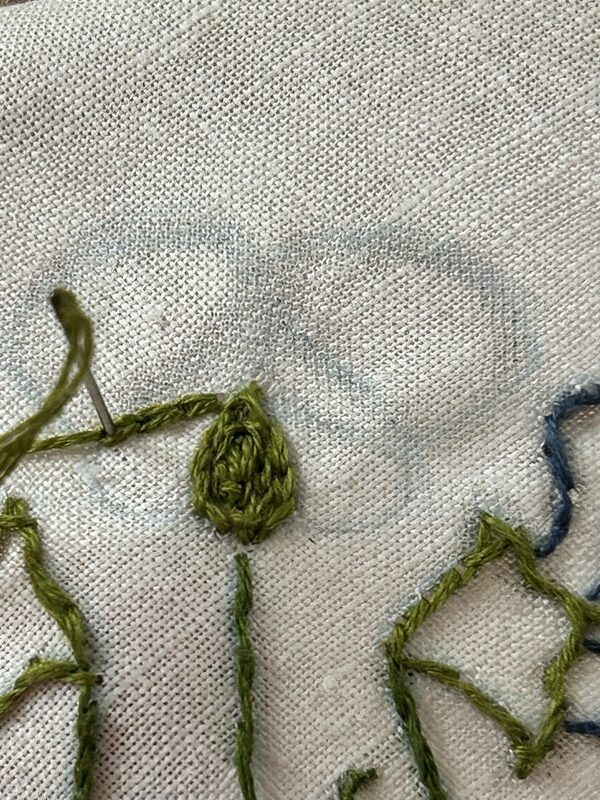
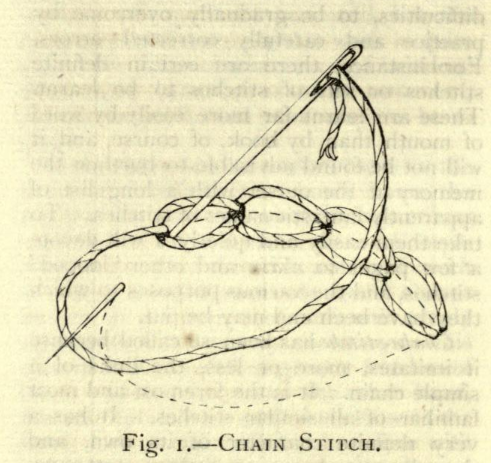
chain stitch example from Decorative needlework
by May Morris 1862-1938The satin stitch, too, required a shift in mindset. I usually default to the “thread‑saver satin,” where the front of the fabric gets the same smooth, flat coverage, but the back is worked with tiny anchoring stitches instead of full repeats. It’s faster, it wastes less thread, and it means fewer interruptions to tie off and rethread all things I like when I’m working on modern projects.
But this project kept nudging me away from speed and convenience. True satin stitch, the kind that mirrors itself front and back, is slower. It eats thread. It forces you to commit to each stroke of the needle. And while it absolutely wrecked my carefully planned timeline and pushed me closer to the deadline than I’d like to admit, I think I’m better for it.
The Arts & Crafts Movement prized slowness, deliberateness, and the dignity of doing something the long way simply because it was the right way. Stitching these leaves made me feel that in my hands. the tug of the thread, the rhythm of repetition, the quiet insistence that beauty takes time.
-

Fashion History
Embroidery has long been intertwined with the history of dress and gender. In early modern Europe, needlework functioned as a marker of refinement and social status. As Jennifer Van Horn demonstrates, embroidered samplers and textiles acted as social documents, evidence of a woman’s discipline, gentility, and place within the household economy.¹
By the nineteenth century, embroidery occupied an even more complex position within fashion. It adorned garments and accessories, yet it also represented a form of gendered labor that was aesthetically prized even as it was socially undervalued. Kathryn King argues that needlework was both a creative and intellectual practice, yet it was frequently dismissed as trivial “women’s work.”² This tension shaped the conditions under which women produced embroidered fashion and helps explain why the Arts & Crafts Movement became such a powerful site for rethinking the relationship between labor and beauty.
The movement’s revival of hand embroidery tried to reframe it as a legitimate art form. May Morris, for example, transformed embroidery from a domestic pastime into a professionalized craft. Her designs for clothing and household textiles emphasized stylized natural motifs, harmonious color palettes, and the expressive potential of stitch.³ Similarly Workshops such as the Dun Emer Guild and Hastings Needle Work, extended this ethos by creating spaces where women could design, produce, and sell embroidered goods.⁴ These workshops blurred the boundaries between fashion, labor, and art, demonstrating that embroidery could be both economically viable and artistically innovative.
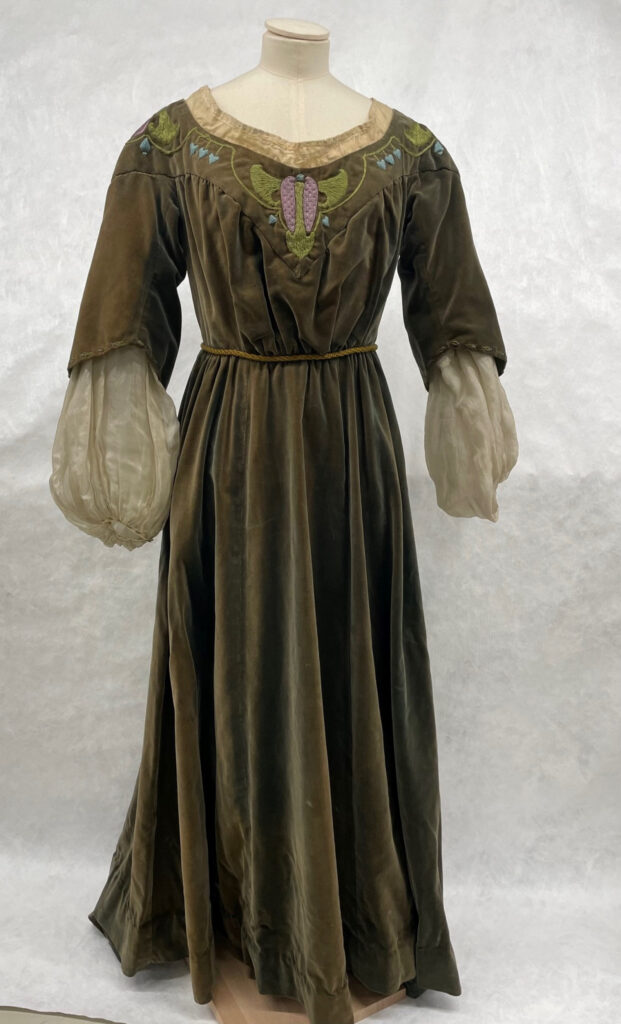
© William Morris Gallery, London Borough of Walthamforest Moreover the Arts & Crafts Movement did not merely influence interiors and decorative arts. It reshaped fashion itself. As the Victoria & Albert Museum notes, the movement encouraged designers to reject the excesses of industrially produced clothing and instead embrace garments that expressed simplicity and ture craftsmanship.⁵ This shift aligned with broader dress‑reform movements that sought alternatives to the restrictive Victorian silhouettes. Arts & Crafts dress favored looser cuts, natural fibers, and ornamentation achieved through handwork rather than machine‑made trims.
Fashion Heritage Europe similarly emphasizes that Arts & Crafts ideals offered “the other side of modernity”: a vision of fashion grounded in slowness and authenticity. ⁶ Instead of chasing novelty, it pushed designers drew on medieval and folk traditions, creating garments that felt timeless rather than trendy. Embroidery became a key site for this philosophy, allowing wearers to display individuality through its patterns and designs As Arts & Crafts aesthetics filtered into mainstream fashion those principles shaped everything from tea gowns to accessories, creating a recognizable Arts & Crafts “look”
This broader history of embroidered dress and accessories provides the context for understanding the handkerchief as a fashion object. Though small, the handkerchief has carried enormous cultural weight. As the Complete Handkerchief History notes, it has long served as a symbol of refinement, flirtation, and social status.⁸ In the Renaissance, Bella Mirabella shows, the handkerchief occupied a limbo space between the intimate and the public: a cloth meant to absorb bodily fluids also signaled hygiene and social identity.⁹ This duality requires distinguishing between the utilitarian handkerchief and the decorative one, the latter functioning as a personal, wearable accessory. Women embroidered decorative handkerchiefs as gifts, love tokens, and ways to display their skill.
These earlier traditions became pillars for the Arts & Crafts Movement, which deliberately revived and romanticized historical approaches to needlework as a way to reclaim authenticity in everyday accessories. By the nineteenth century, decorative handkerchiefs were essential elements of dress for both men and women. They were tucked into sleeves, waistcoats, and pockets. They could be edged with lace, monogrammed, or elaborately embroidered. My project happens to be all three. As Amy Boyce Osaki notes, sewing and needlework were considered “truly feminine employment,” and the handkerchief once again became a canvas on which women demonstrated refinement and technical mastery.¹⁰ Even when small, these textiles participated in the visual language of dress.
Footnotes
- Jennifer Van Horn, “Samplers, Gentility, and the Middling Sort,” Winterthur Portfolio 40, no. 4 (2005): 219–48.
- Kathryn R. King, “Of Needles and Pens and Women’s Work,” Tulsa Studies in Women’s Literature 14, no. 1 (1995): 77–93.
- May Morris, “Embroidery,” The Decorator and Furnisher 21, no. 5 (1893): 178–79.
- Nicola Gordon Bowe, “Two Early Twentieth-Century Irish Arts and Crafts Workshops in Context,” Journal of Design History 2, no. 2/3 (1989): 193–206; Ann W. Braaten, “Hastings Needle Work: Women Creating, Women Providing,” Minnesota History 60, no. 2 (2006): 66–76.
- “How Arts and Crafts Influenced Fashion,” Victoria & Albert Museum, accessed April 2026.
- “Fashion and the Arts and Crafts Movement: The Other Side of Modernity,” Fashion Heritage Europe, accessed April 2026.
- “How the Arts and Crafts Movement Influenced Fashion,” ECER, accessed April 2026.
- The Complete Handkerchief History, Hankybook, accessed April 2026.
- Bella Mirabella, “Embellishing Herself with a Cloth: The Contradictory Life of the Handkerchief,” in Ornamentalism: The Art of Renaissance Accessories (2011), 59–82.
- Amy Boyce Osaki, “‘A Truly Feminine Employment’: Sewing and the Early Nineteenth-Century Woman,” Winterthur Portfolio 23, no. 4 (1988): 225–41.